

Austin Real Estate in 2026: Where Prices Stand, and What 2027-2028 Could Bring
Austin home prices peaked in April 2022 at roughly $565,000, then gave a lot of that back. Four years later, the market is still working through the hangover: prices are down, inventory is way up, and buyers finally have room to negotiate again. At the same time, Austin keeps adding jobs, residents, and semiconductor investment at a pace few U.S. metros can match.
Those two stories, a real correction and a real long-term growth case, are both true at once, and they point in different directions for 2027 and 2028. Here's what the actual data says about where things stand today, what the more credible forecasts project, and what that means if you own a home in Austin or are thinking about buying one.
The Market Right Now
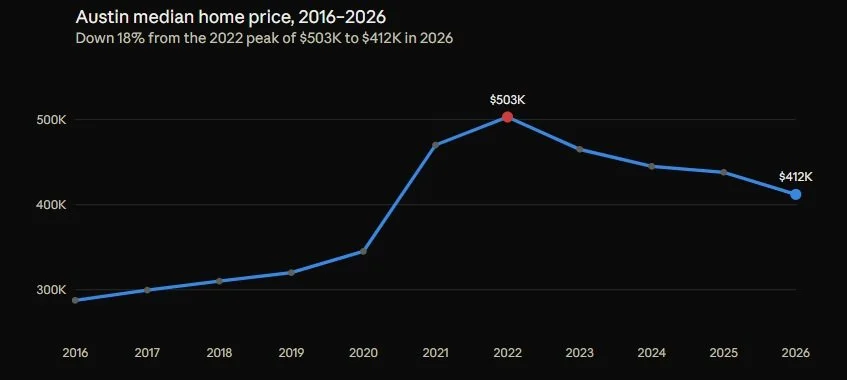
Annual medians smooth out a wilder intra-year swing: the actual peak was $565,000 in April 2022, so the true correction is closer to 27%, not the 18% the year-over-year annual figures alone suggest.
Zillow's home value index for the Austin metro, which tracks typical value rather than sale-price medians, put the figure at $497,418 as of August 2026, down 3.7% over the prior year.
County-by-county, the picture is uneven. Unlock MLS (the Austin Board of REALTORS' listing service) reported these figures for July 2026, the most recent month available:
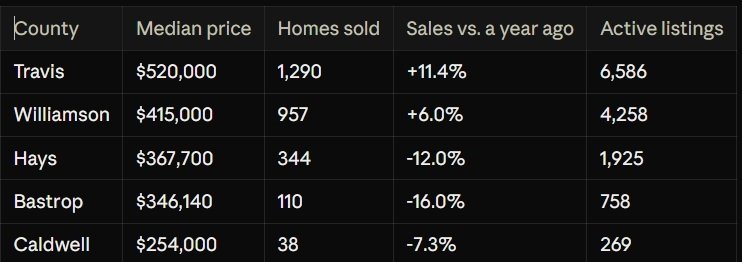
Within the city limits, the median was $577,000, down 1.4% from a year earlier, even as closed sales rose 11%. Across the full Austin-Round Rock-San Marcos metro area, the median was $435,000, with sales up 4.4%. That combination, prices flat to down while sales tick up, is the signature of a market where sellers have adjusted to buyers' terms rather than the other way around.
Why Austin Corrected From Its 2022 Peak
Three things drove the run-up and now explain the pullback:
Rates repriced what buyers could afford. The 30-year fixed rate bottomed near 2.68% in December 2020, letting a given monthly payment stretch much further. By October 2023 it had climbed to 7.62%. A buyer who qualified for a certain payment in 2021 could afford roughly a third less house two years later, which pulled a lot of demand out of the market almost overnight.
Inventory rebuilt from a record low. Active listings in the Austin area fell to around 2,660 in January 2021, an extreme shortage that fueled bidding wars. By June 2026, active listings had climbed to roughly 14,647. More homes for sale, competing for fewer qualified buyers, is the direct mechanical cause of flat-to-falling prices.
Migration slowed from its pandemic-era surge. Austin is still growing, but domestic migration into the metro is now the lowest it has been in 15 years, even as international migration is at an all-time high. The net effect is population growth that continues, just at a less explosive pace than 2020-2022.
Put together, Austin's 2020-2022 boom was a 118% run-up in home values from October 2015 to the April 2022 peak, driven by cheap money and a wave of new residents arriving faster than homes could be built. The unwind since then has been orderly rather than a crash: even after the correction, prices in August 2026 remained about 58.5% above their October 2015 level.
The 2027 Outlook
The most widely cited near-term forecast comes from Zillow, which as of its April 22, 2026 update projected Austin metro home values would fall another 4.6% between March 2026 and March 2027. That's a steeper decline than Zillow's national forecast of essentially flat prices (+0.0%) over the same period, placing Austin among the weaker large metros in its 300-market model, alongside other Sun Belt markets that overbuilt relative to demand.
Mortgage rates are a big part of why. Fannie Mae's August 19, 2026 forecast, revised upward from its July outlook, now projects the 30-year fixed rate averaging 6.8% in the fourth quarter of 2026 and staying at 6.8% through the first half of 2027 before easing slightly to 6.7% in the second half. Fannie Mae attributes the upward revision to rising oil prices, a national debt exceeding $40 trillion, and constraints on how much the Federal Reserve can lower borrowing costs. Rates in the high 6% range keep monthly payments elevated relative to the 2020-2021 window, which caps how much buyers can bid and keeps pressure on sellers in a market that already has more inventory than it did a few years ago.
Put simply: most of the credible near-term data points to a market that keeps cooling gradually through 2027, not one that snaps back.
2028 and the Longer View
No major national research firm (Zillow, Fannie Mae, CoreLogic, or the National Association of REALTORS) has published a metro-level Austin forecast that reaches all the way to 2028. That's worth saying plainly rather than papering over: anyone quoting a precise 2028 number for Austin is extrapolating, not reporting. What follows is the honest range of that extrapolation, from both directions.
The case for continued softening. One local analytics firm, TeamPrice, has built its own model around Austin's price-to-rent ratio, currently around 16.2 versus a historical average near 13.5, and argues homes remain overextended relative to what they'd rent for. Their model projects a cumulative 12.5% decline in median sale price from 2025 to 2028, landing near $357,875, alongside a corresponding pullback in rents. That is one independent analyst's model, not a consensus figure, but the underlying logic, that valuations should eventually reconnect with rental income, is a standard way economists think about housing bubbles unwinding.
The case for stabilization and renewed appreciation. Austin's long-term demand drivers haven't gone away. The Austin-Round Rock-San Marcos metro added more than 267,000 residents between 2020 and 2024 and now has over 2.5 million people, the 25th-largest metro in the country, per Census Bureau data. Samsung's semiconductor campus in nearby Taylor represents a minimum $17 billion investment, with equipment move-in completed in April 2026 and roughly 1,800 direct jobs expected over the site's first decade, a figure that doesn't count the supplier and service jobs a fabrication plant of that scale typically pulls in behind it. If mortgage rates ease as Fannie Mae's own forecast suggests (down to 6.7% by late 2027) while population and job growth continue, the ingredients for a bottoming-out and gradual recovery by 2028 are plausible, even if no one has published a confident number for it yet.
The honest summary: 2027 looks more likely than not to bring further softening, on the weight of the Zillow forecast and elevated rates. 2028 is genuinely unsettled, and depends heavily on whether mortgage rates actually ease as currently projected and whether Austin's job and population growth reaccelerate or continue their gradual slowdown.
What This Means for Buyers, Sellers, and Owners
If you're buying, you have more leverage than at any point since before the pandemic. Inventory is ample, days on market have stretched out, and sellers in most Austin-area counties are adjusting price rather than holding firm. Waiting for a bottom is tempting, but timing a housing market precisely is difficult even for professional forecasters, as the wide range of 2028 estimates above makes clear.
If you're selling, pricing to the current market, not to 2022 comparables, matters more than it did even a year ago. The gap between list price and eventual sale price tends to widen in a buyer's market, and homes priced realistically from the start are still finding buyers, as the sales-volume increases in Travis and Williamson counties show.
If you already own, a paper decline from the 2022 peak doesn't change your monthly payment if you're not selling, and Austin prices remain well above pre-pandemic levels. The more useful question is how a change in your home's value, or a decision to sell, refinance, or tap equity, fits into your broader financial picture: retirement timing, other goals, and overall liquidity.
What Your Home Means for Your Bigger Picture
For most Austin families, home equity is one of the largest pieces of their net worth, which makes real estate decisions financial planning decisions, not just market-timing ones. Whether you're weighing a sale into a softer market, deciding whether to refinance, or thinking about how a paid-off house fits into retirement, those choices deserve the same rigor as any other part of your plan. At Pioneer Wealth Management Group, we've spent over two decades helping Austin-area families think through exactly that, as a fee-only, fiduciary firm with no commissions and no product to sell. We're glad to help you think it through.
Sources
Austin Housing Market Data, 2016–2026 — The Austin Local Group
Austin home sales are on the rise as prices stabilize, new report says — CultureMap Austin
Zillow revises home price forecast across over 400 housing markets — ResiClub Analytics
Fannie Mae sharply raises mortgage rate forecast through mid-2027 — Scotsman Guide
Austin Housing Market Forecast: Will Home Prices Drop 12.5% by 2028? — TeamPrice
Samsung's Taylor chip plant as Austin chases jobs — Hoodline
Quick Answers (FAQ)
-
Yes, in most measures. Zillow's home value index was down 3.7% year-over-year as of August 2026, and the city-limits median was down 1.4% year-over-year in the most recent report. A few surrounding counties, including Hays and Bastrop, actually saw small price increases over the same period, so the answer varies by area.
-
The April 2022 peak was around $565,000. By August 2026, the broader market median had fallen to roughly $412,000, a decline of about 27%. Prices are still well above pre-pandemic levels, about 58.5% above where they stood in October 2015.
-
Most near-term forecasts say no. Zillow's most recent projection (April 2026) called for a further 4.6% decline in the Austin metro between March 2026 and March 2027, driven largely by elevated mortgage rates and ample inventory.
-
There's no reliable consensus number. No major national forecaster has published metro-level Austin projections that far out. One local analytics firm projects a cumulative 12.5% decline from 2025 to 2028 based on price-to-rent ratios, while Austin's continued population growth and major investments like Samsung's $17 billion Taylor semiconductor plant support a case for stabilization. Both are plausible; neither is certain.
-
Record-low mortgage rates (2.68% by December 2020) combined with a surge of new residents and historically low housing inventory (as few as 2,660 active listings in January 2021) to push prices up 118% from October 2015 to the April 2022 peak.
-
By most measures, Austin has shifted toward a buyer's market. Active listings have climbed to roughly 14,647 as of mid-2026, up from under 3,000 in early 2021, giving buyers far more selection and negotiating room than during the pandemic-era boom.
-
That depends on your own timeline, finances, and goals more than on trying to call the exact bottom of the market. Buyers today have more inventory and negotiating leverage than at any point since before the pandemic, but rates remain elevated, which affects what a given budget can afford regardless of where prices head next.