

The Parent’s Guide to Future Savings: 529 Plan vs. Section 530A Account (Trump Account)
As a parent, setting your child up for long-term financial stability is one of the greatest gifts you can offer. For decades, the 529 plan has served as the gold standard for funding higher education. However, with the introduction of Section 530A accounts, parents now have access to a savings vehicle built for early investing and retirement. Section 530A accounts (commonly called "Trump Accounts") are tax-advantaged investment accounts for minors that went live on July 4, 2026.
While both accounts allow you to build wealth for your child, they differ in purpose, tax structure, and who ultimately controls the money. Here is information to help you make the right choice for your family.
1. The 529 Plan: The Parent-Controlled Education Tool
A 529 plan is a state-sponsored investment vehicle designed specifically to cover qualified education costs, including college tuition, trade schools, apprenticeship programs, and K-12 tuition.
Primary Purpose: Qualified education expenses.
Tax Advantage: Contributions are made with after-tax dollars, but all investment growth and withdrawals are 100% tax-free when used for qualified education expenses. In some states, contributions may be tax-deductible.
Contribution Limits: Very high. There is no federal annual limit, though contributions are subject to federal gift-tax exclusion rules (up to $19,000 per donor per year/ $38k per married couple filing jointly in 2026 without triggering reporting), with aggregate state limits often exceeding $500,000 per beneficiary.
Ownership & Control: Remains controlled by the parent (or account holder). Even after your child turns 18 or graduates college, you retain complete authority over the funds, including the ability to change the beneficiary to another relative.
Key Insight: It’s worth highlighting the flexibility of modern 529s. If your child skips college, you can use up to $10,000 to pay down student loans or roll over up to $35,000 of unused funds into a Roth IRA for the beneficiary (subject to lifetime caps and account age rules).
2. The Section 530A Account: The Child-Owned Minor IRA
A Section 530A account functions essentially as a custodial retirement vehicle for children under age 18, designed to give the next generation a multi-decade head start on compound growth.
Primary Purpose: Long-term wealth building, early investing, and retirement security.
Tax Advantage: Tax-deferred growth. Unlike a 529, withdrawals in adulthood do not qualify for tax-free status; instead, distributions are taxed as ordinary income under standard IRA tax rules.
Contribution Limits: Capped at $5,000 annually per child (indexed for inflation starting in 2028). Anyone, including parents, grandparents, relatives, or employers, can contribute toward this annual cap.
Ownership & Control: Owned by the child. While a parent or legal guardian manages the account during the growth period, legal control shifts fully to the child when they reach age 18. At that point, the account converts into a standard traditional IRA in their name.
Key Insight: Unlike a traditional custodial IRA, a major advantage is that children do not need earned income to receive 530A contributions during the growth period (before age 18). Furthermore, eligible children born between 2025 and 2028 can receive a one-time $1,000 federal seed deposit.
Which is Better for Generational Wealth and Legacy Planning?
If you are a parent or grandparent looking to optimize your estate and transfer wealth efficiently, these two accounts operate under different rulebooks:
The 529 Plan is best for "Dynasty" Wealth and Estate Removal. A 529 plan offers a rare legal exception in estate planning: contributions are immediately removed from your taxable estate, yet you maintain complete legal control over the money.
The "Superfunding" Loophole: The IRS allows you to front-load five years of gift-tax exclusions into a 529 all at once. In 2026, a married couple can drop $190,000 per child into a 529 plan on day one, without eating into their lifetime estate tax exemption.
Generational Flexibility: Because the account owner can change the beneficiary to other descendants (grandchildren, great-grandchildren), a heavily funded 529 can act as a multi-generational educational trust that stays in the family for decades.
The 530A Account is best for an "Individual" Financial Head Start. Contributions to a 530A also qualify for the annual gift tax exclusion (and remove money from your estate), but you are capped at $5,000 a year.
The Lock-In Effect: Unlike a 529, a 530A is an irrevocable gift to that specific child. You cannot change the beneficiary to a sibling later on.
The Power of Time: The legacy power of a 530A lies in the sheer math of a 60-year time horizon. Maxing out a $5,000 annual contribution from birth to age 18 can potentially create a multi-million dollar retirement safety net for that individual child by the time they hit their 60s, requiring zero effort on their part.
Head-to-Head Comparison
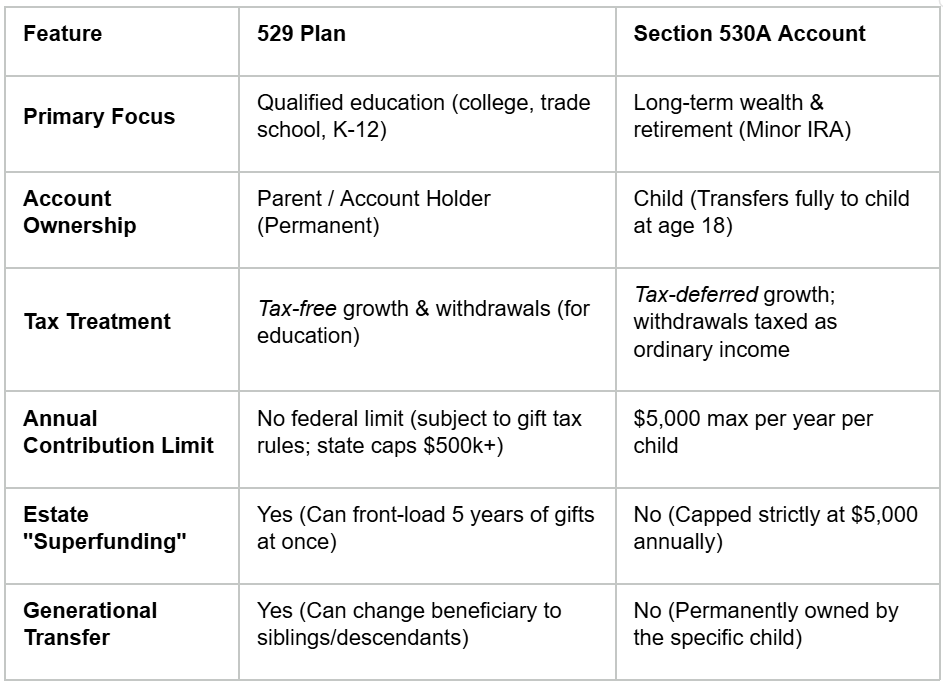
Advanced Stacking Strategies
If you are evaluating both accounts, here are two strategies to maximize tax efficiency:
The "Working Teen" Dual IRA Strategy: Because 530A contributions do not count against standard IRA limits during the growth years (before 18), a working teenager with earned income can max out a personal Roth IRA (up to the annual IRA cap) and still receive up to $5,000 in their 530A account in the same calendar year.
Post-18 Tax Segregation: At age 18, when the 530A converts to a traditional IRA, maintaining it as a separate account prevents it from being aggregated with other IRAs under the IRS pro-rata rule; this can preserve tax flexibility for future back-door or Roth conversion planning.
Decision Matrix: Which Should You Choose?
Choose a 529 Plan if: Your top priority is tax-free funding for college or private schooling, you want to "superfund" a large lump sum to reduce your taxable estate, or you prefer to maintain 100% parental control over the money indefinitely.
Choose a Section 530A Account if: You want to secure a multi-decade retirement foundation for your child, claim the federal seed deposit (for eligible newborns), or take advantage of employer matching programs (employers can contribute up to $2,500 toward the $5,000 annual limit).
The Hybrid Approach: Many parents and grandparents elect to use a 529 plan as the primary vehicle for targeted education goals while maintaining a 530A account to capture employer matches or federal seed funds for long-term growth.
