

Building a Portfolio vs. Chasing Performance - Learning from Recent Market Performance
For roughly five out of the past seven years, U.S. large-cap companies were on fire. The biggest and most popular of these companies dubbed the Magnificent 7 – Apple, Nvidia, Microsoft, Tesla, Meta, and Alphabet - dominated news headlines and water cooler conversations across the country.
Many investors began to believe that US large-cap was the only game in town. As a result, we fielded many questions from clients about whether they should put more money where performance has recently been strong. After all, isn’t it natural to assume that the stocks doing well today will continue to do so in the future?
While this approach can seem like the right move in the moment, counterintuitively, it is rarely a sound investment approach. In fact, this error is so common among investors that it has been dubbed “performance chasing” and has not-so-positive connotations.
Surprisingly, in 2025, while many investors continued to focus on the largest U.S. companies, diversified emerging markets funds were secretly outperforming behind the scenes. Last year, emerging markets economies like Colombia, South Korea, Peru, and others, helped contribute to a 33.57% return in the emerging markets asset class (as measured by the MSCI Emerging Markets Index), vs. a 17.88% return for the US large cap asset class (as measured by the S&P 500 Index).
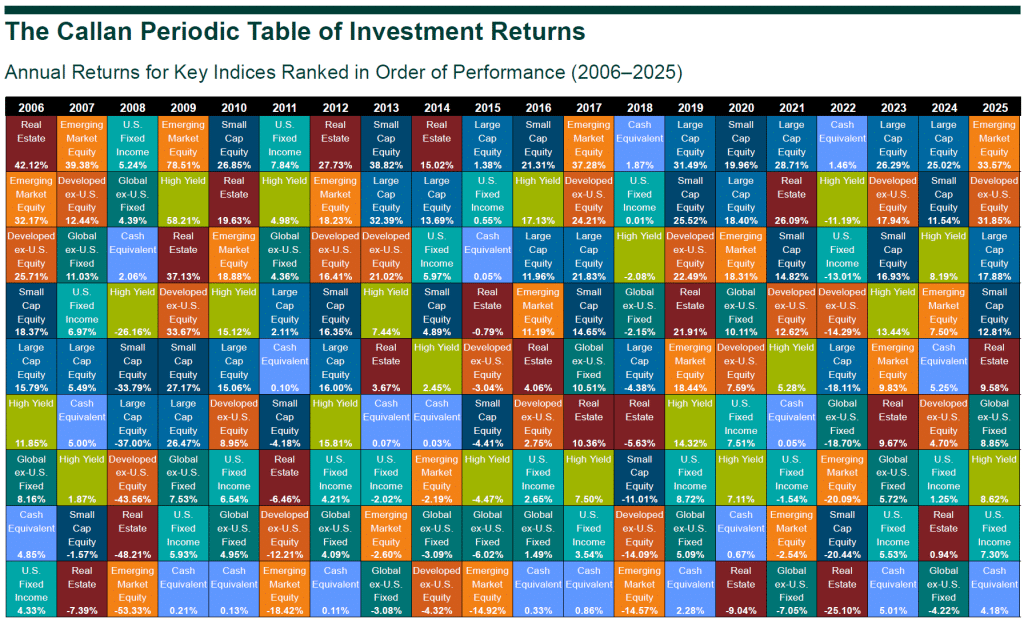
Credit: The Callan Institute
This outperformance among emerging markets has so far continued into 2026. As of April 29, 2026, the Vanguard Growth Index Fund ETF Shares (VUG), an ETF tracking the largest US growth companies, has underperformed Dimensional Fund Advisors’ Emerging Core Equity Market ETF by roughly 13% year-to-date, before fees.
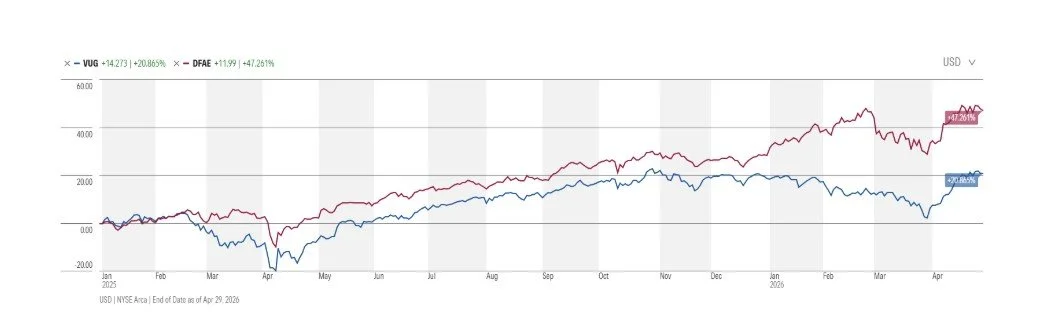
Linear performance of VUG (blue) versus DFAE (red) from January 1, 2025 through April 29, 2026, gross of fees.
This shift highlights a fundamental principle of investing: yesterday’s winners (or even today’s winners!) are not a reliable predictor of tomorrow’s performance.
In fact, research from Dimensional Fund Advisors shows that companies who make it to the top 10 largest in the US stock market tend to underperform the overall market. In other words, these companies tend to outperform on their way up and underperform once they get there.
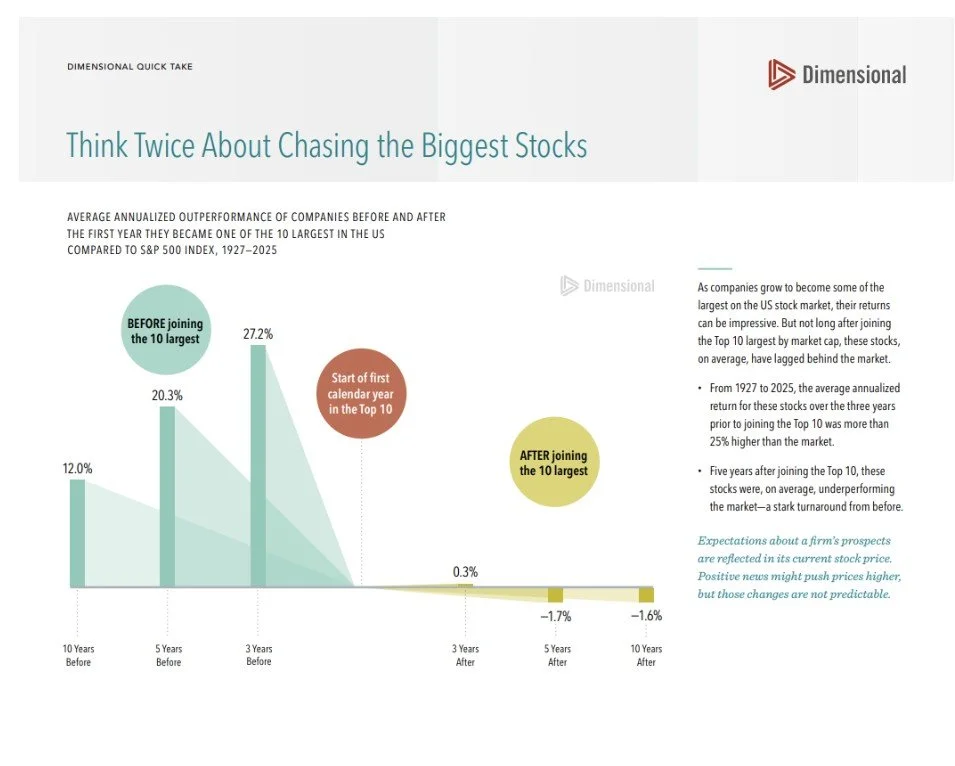
For investors, diversification remains the most reliable long-term approach. Spreading investments across industries, sectors, and geographies helps ensure that a portfolio isn’t overly dependent on any single outcome. When one area underperforms, another area will likely be doing well. And when markets inevitably shift, the diversified portfolio is already positioned to participate in strong performance wherever it is showing up.
The information presented is for educational purposes only, is believed to be factual and up-to-date, and is not presented net of fees. All expressions of opinion reflect the judgment of the author(s) as of the date of publication and are subject to change. Nothing in this blog should be construed as investment advice and does not take into consideration your specific situation. All investments involve risk. Past performance does not guarantee future results. Advisory services offered through Pioneer Wealth Management Group, Inc., an investment adviser registered with the U.S. Securities and Exchange Commission.