

Got Stock Options? Maybe 83b It.
Nobody Warns You About the 30 Day Clock
There's a particular kind of phone call we get often and wish folks contacted us sooner.
Someone joins a startup, or gets promoted into an equity grant, or finally exercises options they've been sitting on for years. They're thrilled. They send over the paperwork so we can plan around it. And somewhere in that stack, I find a grant date that's sixty days old. Which means a decision that was available to them is now gone. Permanently. It can't be appealed, extended, or fixed with a good excuse.
That decision is the Section 83(b) election. I want to talk about it in plain English, because most of what's out there is either three sentences long or written for tax attorneys.
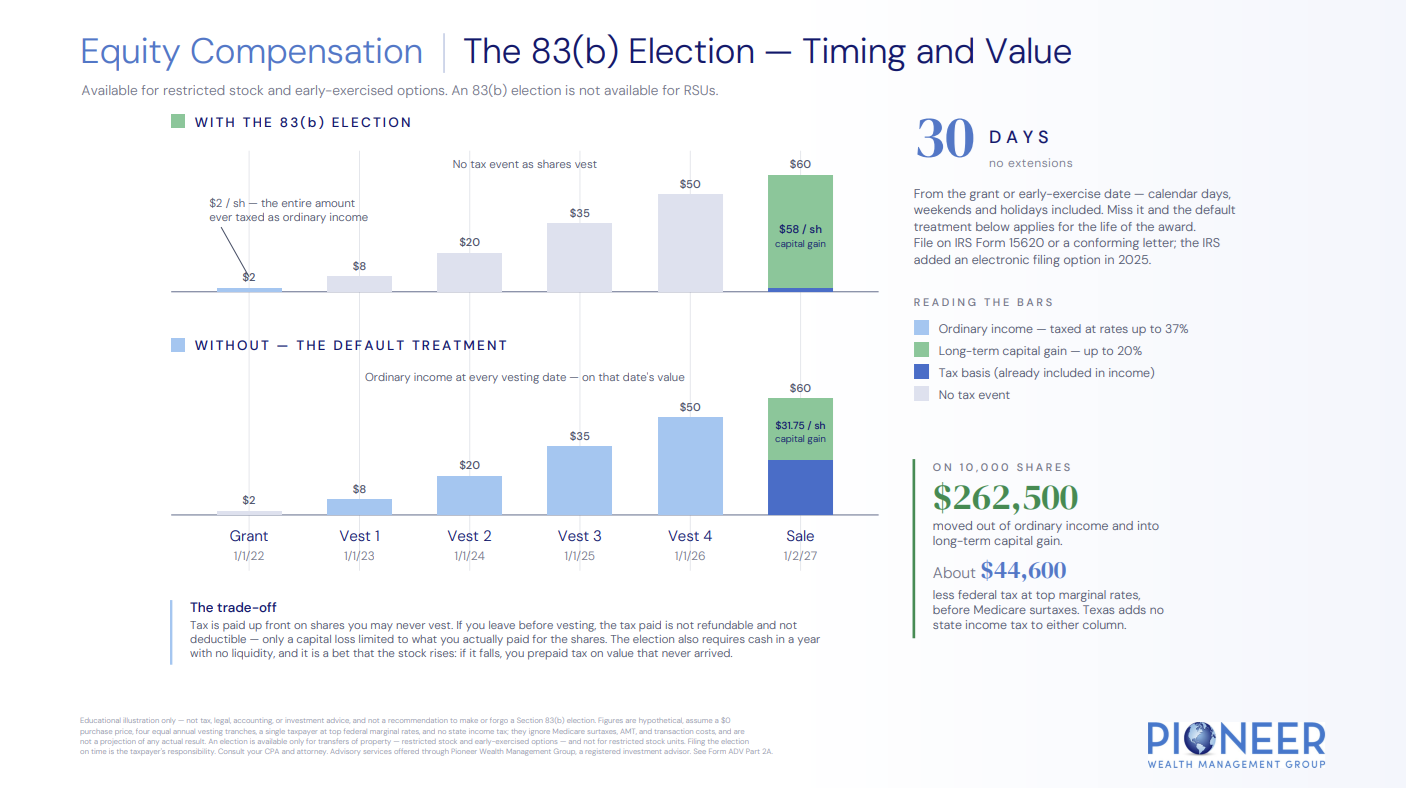
The default rule, and why it becomes a problem
Here's the setup. You get shares that vest over time. Restricted stock, say, or options you exercised early. The shares are yours in name, but you can lose them if you leave before they vest. The IRS looks at that and says, reasonably enough, that you don't really own something you might have to hand back. So it waits. Each year, as a chunk vests and becomes truly yours, the IRS taxes you on what that chunk is worth that day. As ordinary income. At your regular rate.
That sounds fine right up until the company does well.
Because now the thing you're taxed on isn't the modest value it had when you got it. It's whatever it grew into. Every year the company gets more valuable, your tax bill gets bigger, and all of that growth gets taxed as ordinary income instead of capital gain.
You didn't sell anything. You just vested. And you owe money.
What the election actually does
Section 83(b) lets you raise your hand and say: tax me now, on today's value, before any of this grows. That's the whole idea. You volunteer for a tax bill today in exchange for not having one at every vest. Everything the shares gain from that point forward becomes capital gain instead of ordinary income, and your clock for long term treatment starts immediately rather than restarting at each vesting date. When you get the shares early and they're worth very little, the tax bill you're volunteering for is tiny. Sometimes it's zero.
The numbers, because this is where it lands
Let’s use round numbers.
Say you receive 10,000 shares of restricted stock. You pay nothing for them. They vest over four years, 2,500 per year. On the day you get them, they're worth $2 each.
Then the company does what everyone hopes it does. By the first vest the shares are worth $8. Year two, $20. Year three, $35. Year four, $50. You sell a year after that at $60.
Without the election, you're taxed at each vest on that year's value. Add it up and you've reported $282,500 of ordinary income over four years. On shares you never sold. In years when you may have had no cash to pay the bill.
With the election, you report 10,000 shares times $2. That's $20,000, once, in year one.
Same shares. Same sale. Same $600,000 at the end. The difference is that $262,500 moved out of ordinary income and into long term capital gain. At top federal rates that's roughly $44,600 less in tax. And here in Texas we don't stack state income tax on top of either column, so that number is the whole story in a way it wouldn't be in California.
I keep a chart of this on hand for client meetings, because the shape of it lands faster than the paragraph does.
The 30 days are real
This is the part I want to be blunt about. You have 30 days from the date the shares are transferred to you. Calendar days: weekends and holidays count. The clock starts the day after the grant or the early exercise.
There's no extension. The 30 days come from the statute itself rather than from a regulation, which is why the usual relief routes for a missed election don't apply here, and why the Tax Court has been so consistently unsympathetic about it.
The good news is that the filing got easier. The IRS finally published a standardized form, Form 15620, and as of 2025 there's an electronic filing option that gives you immediate confirmation of receipt. If you mail it instead, use certified mail with a return receipt and put that receipt somewhere you'll still be able to find it in six years. You also need to give a copy to your company.
It's one page. It takes about fifteen minutes. The hard part isn't the form. The hard part is knowing the clock exists.
When the election is a bad idea
Most articles stop at the tax savings. I'd rather you hear the other half from me than learn it the expensive way.
You're paying tax on shares you might never own. If you leave before vesting, or the company folds, or the shares get clawed back, that tax is gone. No refund. No deduction. The most you get is a capital loss limited to what you actually paid for the shares, and if you paid nothing, that's nothing.
It takes cash in a year when you have none. The election creates a tax bill at exactly the moment the shares are worth something on paper and nothing in your checking account. You usually can't sell shares to cover it, because they're neither liquid nor vested.
It's a bet that the stock goes up. If the value falls, you prepaid tax on a number that never showed up.
So the math isn't automatic. When you receive shares early, at a very low value, and you intend to stay, the election is close to a no brainer, because the cost of being wrong is small. When the spread is already meaningful, the tax bill is real money, and your plans are genuinely uncertain, it turns into a real decision with real trade offs. That's a conversation, not a calculator.
The RSU trap
One more thing, because I field this question constantly. If you have RSUs, restricted stock units, you cannot make an 83(b) election. Not "it's usually a bad idea." You cannot.
The election applies to transfers of property. An RSU isn't property. It's a promise that the company will deliver shares later. There's nothing to elect on yet. This trips up a lot of very smart people, because RSUs and restricted stock sound like the same thing and get abbreviated almost identically. They aren't. Restricted stock awards and early exercised options qualify. RSUs don't.
What to do this week
If you've received equity in the last month, or you're about to:
Find the actual date. The grant date or the exercise date, from the actual document, not from memory.
Count 30 calendar days forward and put it in your calendar today.
Figure out what you actually hold. Restricted stock, early exercised options, and RSUs are not interchangeable.
Ask what the shares are worth right now and what you paid. That difference is what you'd be taxed on.
Talk to someone before the deadline, not after.
That last one is the only reason I write posts like this. The analysis isn't hard. The deadline is just quietly, permanently fatal, and almost nobody mentions it in the excitement of getting the grant.
One last thing
We've been in Austin for 23 years. In that time we've watched this city turn into a place where a lot of people's net worth shows up in the form of company stock. That's a good problem to have. It's also a problem that arrives with a lot of small deadlines nobody circles for you.
If you're sitting on a fresh grant and you're not sure what you've got, the conversation is free and it's short. We'd much rather answer the question in week two than explain the math in month three.
This is educational and not tax, legal, or investment advice, and not a recommendation to make or skip an 83(b) election. The figures are hypothetical, assume a $0 purchase price and four equal annual vesting tranches, use top federal marginal rates, and ignore Medicare surtaxes, AMT, and transaction costs. Your own outcome depends on your grant terms, your holding periods, and your tax picture. Talk to your CPA and attorney. Advisory services offered through Pioneer Wealth Management Group, a registered investment advisor. See our Form ADV Part 2A.

Quick Answers (FAQ)
-
An 83(b) election allows someone receiving certain substantially nonvested property for services to elect to recognize taxable compensation when the property is transferred instead of waiting until it vests.
-
Generally 30 days after the property is transferred.
This is one of those tax deadlines where procrastination can be expensive.
-
Generally no.
RSUs typically represent a promise to deliver stock later rather than an immediate transfer of property.
-
Usually not when the option is granted.
In some situations, an employee can early exercise an option and receive restricted shares. An 83(b) election may then become relevant to the shares received.
-
Not necessarily.
If the stock's fair market value is equal to what you paid for it, the taxable amount could be zero.
This is one reason founders and very early employees often consider making the election soon after receiving stock.
-
That is one of the risks.
You may have paid tax when you made the election and later discover that the stock has little or no value.
-
You may forfeit some or all of the shares depending on the company's agreement.
Generally, you do not simply get back the income tax you paid because the shares were forfeited.
-
No.
It can affect when the holding period begins and how appreciation is taxed, but the ultimate tax treatment depends on the type of equity, how the stock was acquired, how long it is held, and other tax rules.
-
The current rules no longer require taxpayers to attach a copy of the 83(b) election to their federal income tax return. The election itself still needs to be filed properly and on time with the IRS, and copies generally must be provided to the required parties.
-
A CPA or attorney can certainly help prepare the election, but the 30-day deadline makes this something you should address immediately.
Do not assume your employer, payroll department, attorney, CPA, or financial advisor has automatically filed the election for you.
Make sure you know who is responsible.